
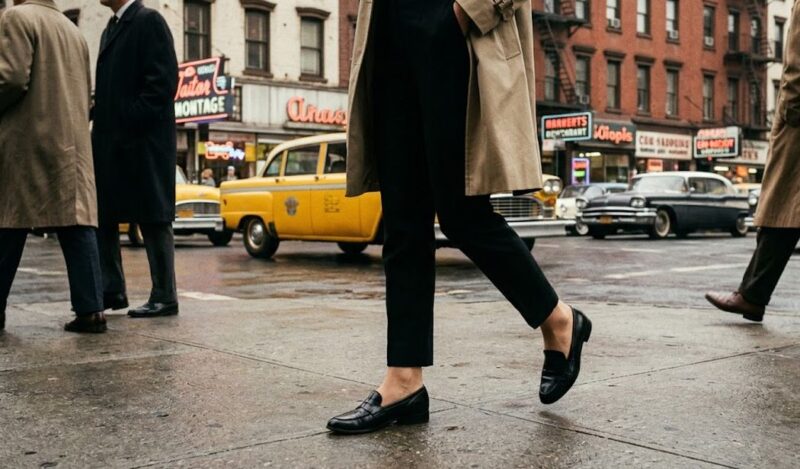

New York style changes every season, yet a certain kind of dressing never really leaves. You still see it on uptown blocks, in office lobbies, outside old restaurants, on subway platforms, and during fashion week when the noise dies down and the strongest outfits are often the simplest ones.
A good loafer, a crisp shirt, a narrow trouser, a wool coat, a leather belt, a navy blazer: old-school New York style survives because it was built for a city that rewards sharp judgment, restraint, and clothes that can move from morning to midnight without falling apart.
The city’s fashion history, from the Garment District to modern street style, helps explain why.
What “Old-School New York Style” Actually Means

At its core, the look is less about one decade than about a narrow style vocabulary repeated across generations. Some pieces shift in cut or finish, but the backbone stays familiar.
Core Pieces of the Look
- Leather loafers, often penny or horsebit styles
- Cigarette trousers or other clean, tapered pants
- Oxford shirts and fine knits
- Navy blazers, camel coats, trenches, and topcoats
- Structured handbags or briefcases
- Quiet jewelry, watches, and belts
- A neutral palette built around black, navy, charcoal, camel, cream, and white
None of that sounds radical, which is exactly the point. Old New York dressing tends to trust shape, fabric, and fit more than loud styling tricks.
Vogue’s 2026 wardrobe essentials guide frames the same logic in modern terms, describing capsule staples and foundational pieces as the clothes people return to season after season.
Note: For anyone leaning into that part of the look, a structured carry piece from Grainmark Leather would sit naturally within the same wardrobe language.
Loafers – A New York Shoe With Staying Power
@ootd
We’ve been spotting lots of summer loafers, and @Rothy’s definitely got the memo
#rothyspartner
#ootd
#nyc
#summer
#outfit
#inspo
♬ Young Blood – The Naked And Famous
Loafers are probably the clearest example of how old-school style keeps renewing itself. They have enough structure for work, enough ease for city walking, and enough history to signal taste without trying too hard.
Vogue called classic leather loafers a smart investment in early 2026, arguing that they work with everything from denim to tailoring and improve with wear.
Earlier coverage from Vogue also noted that loafers remained active on runways, although designers kept reworking the shape in softer or more relaxed directions.
That matters because it shows how a traditional shoe survives: not by staying frozen, but by accepting small updates while keeping its basic identity intact.
Even the most famous luxury loafer has a New York angle. Gucci’s Horsebit loafer, introduced in 1953, remains one of the most durable examples of the form, and the house still presents it as a lasting icon more than 70 years later.
Fashion writing on the item has long tied part of its appeal to the American and preppy worlds that New York helped popularize.
In practical terms, loafers suit New York because they sit between categories. A sneaker can feel too casual. A heel can become exhausting. A formal lace-up can look rigid outside a narrow office environment. The loafer solves all three problems.
Why Loafers Work So Well in the City
| Feature | Why It Works for New York Life |
|---|---|
| Slip-on design | Easy to wear on busy mornings and quick enough for everyday city routines. |
| Structured shape | Keeps an outfit polished without feeling overdone. |
| Flat or low heel | Practical for walking, commuting, and long days across the city. |
| Works with tailoring | Pairs naturally with trousers, skirts, denim, coats, and office-ready layers. |
| Ages well | Quality leather often develops more character with regular wear. |
Cigarette Trousers and the Return of the Narrow Line
For a while, fashion conversation leaned heavily toward oversized tailoring and wide-leg pants. That silhouette is still around, but slimmer trouser lines have returned in a noticeable way.
Cigarette trousers, or pants cut close through the leg and usually ending near the ankle, carry a mid-century mood that feels especially at home in New York. They look composed, urban, and efficient.
Vogue reported in 2025 that cigarette pants were coming back into view, especially through runway styling and sharper bottom silhouettes. Cigarette cuts are slim, tapered, and ankle-grazing, with enough polish to revive older tailoring codes without looking costume-like.
That shape also works with loafers for a simple reason: you can actually see the shoe. Proportion matters more in New York than many people realize.
Narrow trousers keep the lower half clean, make layering easier, and fit well under long coats. In a city where outerwear plays a major role for much of the year, a neat line through the ankle and foot still reads as intentional.
A City Built on Tailoring
Old-school New York style would not exist in its familiar form without the city’s history of tailoring, manufacturing, retail, and fashion labor. The Garment District’s rise in the early 20th century created a dense ecosystem of designers, factories, cutters, pressers, showrooms, and buyers.
According to the Garment District Alliance, the neighborhood became a major center of American fashion design after 1919.
The Library of Congress traces related milestones through department stores, the garment trades, and wartime shifts that helped New York gain fashion authority while Paris was constrained by war.
That background helps explain why New York style often privileges garments with a tailored backbone, even in casual form. A trouser may be cropped. A blazer may be softened. A loafer may be chunkier or sleeker depending on the year.
Yet the underlying idea stays close to classic dress: clean lines, proper shoulders, real shoes, and clothing that respects the body without overwhelming it.
Women, Trousers, and Urban Independence
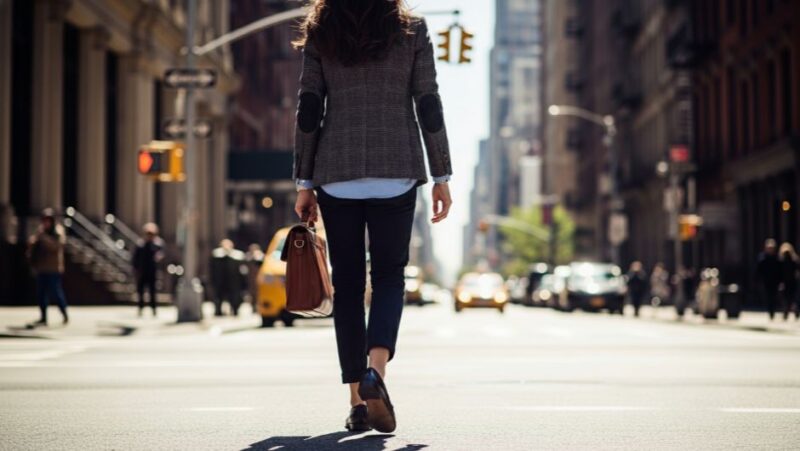
Part of the power of old-school New York style comes from the way women adapted and reshaped tailoring over time. Fashion history at FIT notes that the late 19th century saw public debate around women wearing trousers and bicycle suits, which linked dress reform to freedom of movement.
By the 1920s, sportswear worn as daywear became increasingly accepted for women. Later decades brought sharper, more streamlined pants and tailoring into everyday life.
New York became a natural setting for that evolution. Women working, commuting, editing magazines, buying fabric, running offices, or moving across the city needed clothes with authority and mobility.
Cigarette trousers, loafers, trim knits, and wool coats made sense in that context. Audrey Hepburn may not belong to New York alone, but Vogue’s 2025 review of her wardrobe still highlighted her pairing of black cigarette pants and penny loafers as a timeless formula.
That combination remains easy to spot in New York because it still solves the same styling problem: how to look refined without looking overdressed.
The Quiet Influence of Prep, Workwear, and Black Style
Old-school New York dress often gets described in narrow, upper-crust terms, but the city’s style history is broader than that. Prep certainly matters. So do Wall Street codes, private school uniforms, and old department-store polish.
Yet New York style was also shaped by downtown workwear, immigrant tailoring traditions, Black sartorial culture, and the social theater of Harlem and other neighborhoods.
The Met’s 2025 exhibition Superfine: Tailoring Black Style centered Black style and dandyism as major forces in fashion history, stressing the role of sartorial style in identity formation across centuries.
Material from the exhibition also points to Harlem’s long cultural influence on tailoring and presentation.
Any serious account of New York style has to include that history, because polished dress in the city was never owned by one class or one neighborhood. It has always involved reinterpretation, performance, resistance, and pride.
Why the Aesthetic Keeps Coming Back
Fashion returns to old-school New York codes again and again because the formula still works under modern pressure. People want clothes that can cross settings, last longer than one season, and project competence without too much explanation.
In uncertain economic periods, that instinct often gets stronger. Heritage shapes, good leather, dark wool, and sharp trousers carry a sense of permanence that trend-heavy wardrobes often lack.
Recent fashion coverage supports that pattern. Vogue kept pointing readers toward wardrobe essentials and classic loafers in 2025 and 2026, while Harper’s Bazaar highlighted the continued appeal of polished footwear and practical New York street style. Even when silhouettes change, the appetite for restraint stays strong.
Signs the Style Is Still Alive Right Now
- Loafers continue to appear in runway and shopping coverage as a core footwear investment.
- Cigarette-style pants have returned to trend reporting, especially as a sharper alternative to very loose shapes.
- New York Fashion Week street style still leans on staples like shirts, trench coats, leather shoes, and tailored layers.
- Museums and cultural institutions are still framing tailoring as a living subject, not a dead archive.
How to Wear It Without Looking Like a Costume
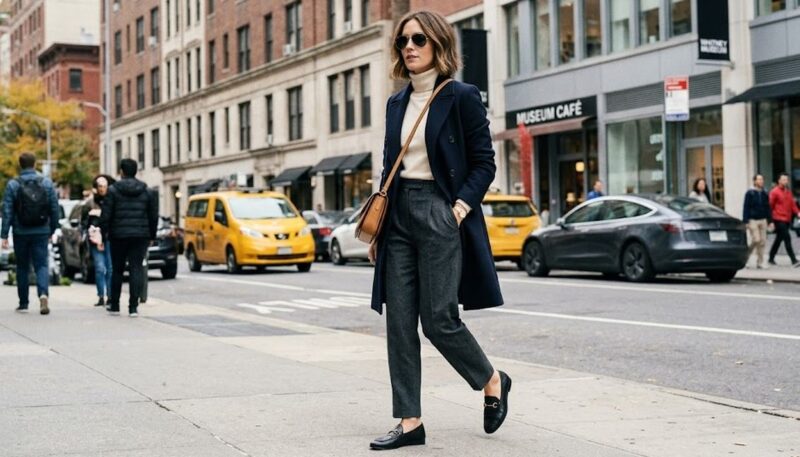
One reason old-school New York style survives is that the best versions never look theatrical. The goal is not to recreate 1958, 1986, or some fantasy of the Upper East Side.
The goal is to borrow the discipline of older dressing while keeping the outfit grounded in present life.
A few rules help:
01 / Keep the Palette Controlled
Black, navy, camel, grey, cream, and white do a lot of heavy lifting. Such colors let texture and tailoring speak first.
02 / Prioritize Shoes and Trousers
A strong loafer and a well-cut trouser can make a basic outfit look finished even when the top half is simple.
03 / Avoid Over-Styling
Too many vintage references at once can turn the look into performance. One or two old-school cues are enough.
04 / Let Fabric Carry the Message
Wool, cotton poplin, suede, leather, and cashmere all age better than flimsy materials and fit the spirit of the style more naturally.
Old New York Style in One Sentence
Put plainly, old-school New York style is what happens when elegance gets disciplined by weather, walking, work, and a city that respects clothes with backbone.
Summary

Loafers and cigarette trousers are still alive in New York because the city still has use for them. Old-school dress survives when it remains useful, and few places test usefulness as hard as New York.
Trends will keep shifting, but a sharp shoe, a clean trouser, and a coat with presence are unlikely to vanish from a city built on movement and style literacy.